How Can Digital News Publishers Protect Their Content in the Age of AI?
The internet has made publishing content more accessible than ever. All it takes is a few clicks for digital news organizations to reach millions of readers. In tandem, generative AI provides a new avenue for content creation, allowing newsrooms and contributing staff to rapidly produce and refine articles.
But speed comes with a tradeoff. As AI-generated content becomes increasingly common, digital media publishers face two new challenges: determining whether content creates potential plagiarism or IP infringement risks, and understanding whether work presented as original reflects genuine human thought or was generated by AI. Both impact their bottom line.
AI Is Raising New Questions About The Value of Content
One of the biggest concerns to come from the rise of generative AI is the prevalence of AI plagiarism. When AI-generated content is submitted as original work, publishers may not always know whether it draws too heavily from existing creators, websites, or previously published material, unintentionally creating potential IP infringement risks and new challenges for editorial teams responsible for maintaining authenticity. If content that isn’t truly original makes its way into publication, it can undermine the value readers expect from premium journalism. Subscribers have an inherent expectation that the news they pay for is premium journalism that is authentic, original, and not something they can get elsewhere for free.
AI-written content isn’t a fringe issue anymore, as roughly half of all articles, blog posts, and listicles published online today are primarily AI-generated. That practice is already fueling a wave of copyright infringement lawsuits against AI companies, leaving news organizations exposed on two fronts at once: content that isn’t as original as it looks, and journalism harvested to train the very models producing it.
In that environment, maintaining editorial quality now also requires more than an experienced and efficient staff. It also requires consistent, scalable verification.
Originality Shouldn’t Slow Down Workflow
As publishing volumes continue to grow, AI verification needs to happen the moment content enters the editorial pipeline, not as a separate, manual task editors have to chase down later.
That’s where Copyleaks helps.
Copyleaks combines AI detection, plagiarism detection and grammar analysis to help editors evaluate submitted content – specifically through our core capability, AI Logic. Rather than providing only a percentage score of what is or isn’t AI, AI Logic offers much-needed transparency into which phrases, passages, and language patterns contributed to the AI determination, giving editors and publishers more confidence when making editorial decisions. This additional visibility helps organizations enforce internal AI governance policies, while maintaining the originality standards that the public increasingly expects. Instead of asking editors to painstakingly investigate every article, verification is now a streamlined process that scales alongside content production.
Bringing Enterprise Content Verification Directly Into WordPress
With Copyleaks’ WordPress integration, that process is now even simpler.
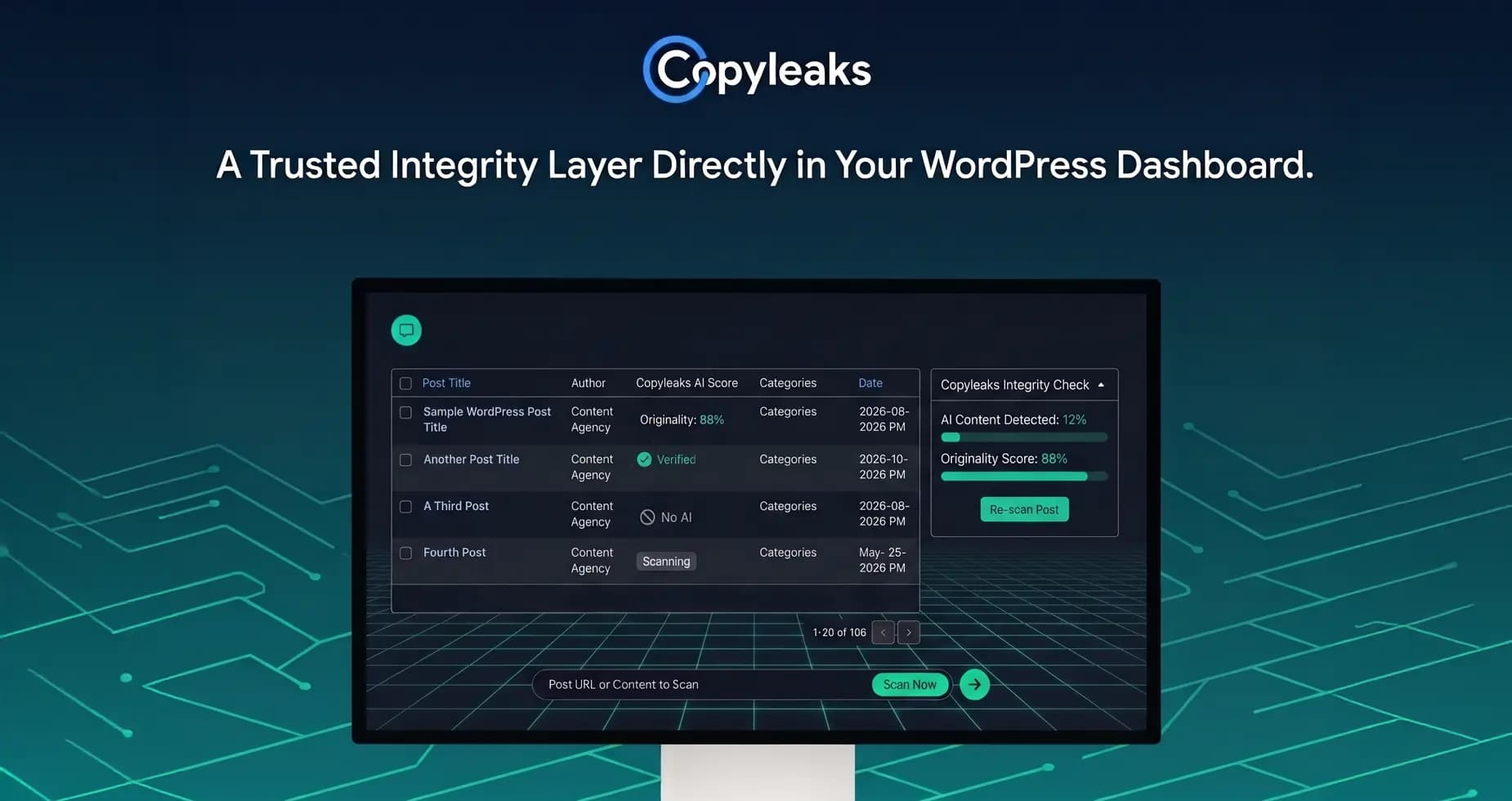
Our new integration brings enterprise-grade AI and plagiarism detection directly into one of the world’s most-used content management systems. Now, creators and editors are no longer required to move content between different platforms before publishing.
The integration fits naturally into existing editorial workflows. As soon as a post moves into the “Pending” stage, Copyleaks automatically analyzes the content on the backend, providing AI, plagiarism, and grammar scores directly within WordPress’s dashboard.
For organizations publishing at scale, automation is just as valuable as accuracy. Verification happens automatically while teams continue working as they normally would, helping secure brand reputation without slowing production.
Organizations using other content management systems can access these same tools through the Copyleaks API, making it easy to fold AI detection and/or plagiarism analysis into virtually any publishing workflow.
Building a More Trusted Publishing Ecosystem
As AI keeps reshaping digital publishing, trust will be an increasingly important differentiator.
Readers want confidence that the content they’re consuming reflects genuine expertise. Publishers need easy ways to maintain editorial standards without losing efficiency. And organizations adopting AI need tools that help enforce the governance policies they’ve established.
AI will continuously transform how people create content. The publishers that succeed won’t be those who avoid AI altogether – they’ll be the ones who use it responsibly while giving readers confidence that what they’re publishing is authentic, original, and worthy of trust.