AI Homework Helper Hidden Costs and the Future of Learning

It’s only natural that an AI homework helper feels like the ultimate academic hack to many students – you get a 24/7 private tutor that always has an answer, never gets tired and is never too busy to help. But, as with all things AI, it’s not that simple.
Any student who lets these AI helpers take over the assignment without being involved at all has to somehow bypass AI detector software. When we trade the effort learning requires for the ease and speed of an algorithm, we pay a price higher than the monthly subscription: we offload our critical thinking to a machine.
Even though the short-term benefits are clear, the long-term impact on cognitive development and critical thinking, not to mention academic integrity, depends on how you use the technology: as a study partner, or an answer machine.

Effective Digital Tutor
An AI homework helper is at its best when it’s used as a tutor, not a student replacer. Judging by student testimonials, these tools are most effective when they help break down complex problems into manageable steps and provide clarification on homework assignments. With this approach, instead of just giving students the final result, the AI homework helper helps them find the logic that leads to the solution.
What this means is that the true value of these helpers comes from using them as a guide and not a shortcut. Furthermore, when students try to tackle homework on their own and then use the AI to check their work and understanding, these technologies reinforce and even enable learning instead of replacing it.
The Detection Game: Canvas and Beyond
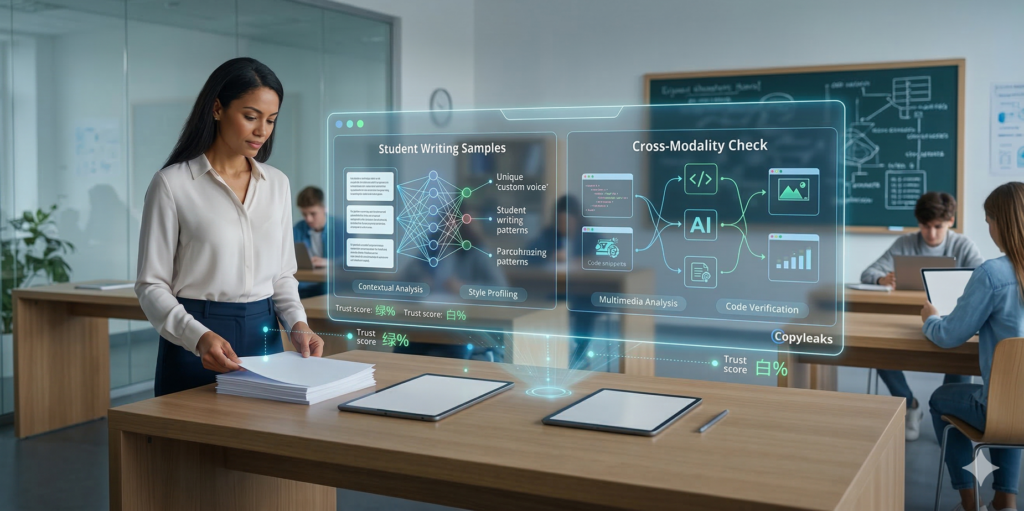
Schools caught up with the AI evolution and started using software like the Canvas AI detector to monitor student submissions. In response, students started looking for ways to bypass AI detector algorithms.
For many, the main question is: Is there an AI that can’t be detected? While some tools promise to generate texts that sound and pass as human, the reality is that detection tools are more like a moving target. It is very risky to rely on an AI homework helper output and hope it won’t get flagged by an AI detector. And even those who do manage to bypass the AI detection tools are left with the same problem: the work isn’t theirs and they haven’t actually learned anything.
The Hidden Cost
The primary hidden cost of overly relying on an AI homework helper is the potential to lose deep understanding. It’s plain to see that if a student only copies and pastes answers without understanding their assignment, they are cheating not only the system, but mainly themselves out of the learning process. True understanding can only come from engaging with the material, or at least trying to at first.
According to the BBC Bitesize guide on AI, there’s a real risk that students develop a passive dependency on these tools. When you take the effort of learning out of the equation, you don’t allow your brain to form the neural connections it needs to retain information for the long term. In essence, what you get from using the shortcut an AI homework helper can offer is a shallow understanding, at best, that won’t stand up to more crucial circumstances, like exams or real-world implementation.

From Answer Machines to Study Partners
Students and educators alike are trying to mitigate these hidden costs by advocating for the right way to utilize AI homework helper tools. As mentioned, the most effective way to use these tools is as a tutor or coach.
Here are three ways to help students stay actively engaged while using an AI homework helper.
- The two-way learning loop
Students should try to solve the problem or complete the assignment first, before they ask the AI tool for an answer. Once they’re done, they can ask the AI to go over their work and explain why the steps they took are correct, or where and why they were wrong.
This approach doesn’t harm the critical thinking process and encourages students to engage with the material.
- Practice materials
AI homework helper tools are at their most powerful when used to generate quizzes, practice questions, or variations on a problem. This replaces passive non-learning with active application.
- Alternative approaches
Instead of accepting the single solution or answer generated by the AI homework helper, students should ask the tool to do two things: explain its answer in multiple ways, and suggest alternative answers.
The Ethical Line
What determines if the ethical line of using an AI homework helper was crossed is intent. Students who use these tools for guidance and as a study partner stay within the ethical boundary, while those who treat the tool like an answer machine cross it.
In a New York Times report on student perspectives, students said they feel either guilt or learning loss when they use AI to avoid difficult assignments. The article added that some students “worried that the technology was becoming a crutch and that, eventually, it may stop adolescents from learning to think for themselves.”
The New York Times report also found that there is a consensus among successful learners: setting personal rules is the best way to continue learning while using AI. For example, a rule could be to never use the AI for direct answers before the student has written their own answer first.
Algorithmic Dependency and Cognitive Offloading
Cognitive offloading is a term psychologists use to describe one of the main concerns of using AI learning tools. When students rely too heavily on AI to perform learning tasks, they weaken their biological memory and problem solving abilities. When an AI homework helper solves a math problem or writes an essay, students are saving time; but, they are also avoiding the effort and difficulty that’s scientifically required to move information from short-term to long-term memory.
Research has long found that struggling to figure out a problem is the point when the most profound learning happens. When you remove that cognitive friction, students could feel like they understand the subject matter when, in reality, they cannot perform once that tool is taken away.
The Case for Privacy and Digital Footprint
Data privacy may not be the issue, but it is an issue nonetheless.
Using an AI homework helper often involves providing details and data, such as personal information, writing samples or proprietary materials. According to a guide written by the BBC, students must be aware of how this data is being stored or whether it will be used by the model for future training.
If an AI tool records every mistake, information or query, it essentially means that it creates a permanent digital footprint for the students. This data could be used in ways students did not intend. To offset this risk, it is crucial to understand the tool’s terms of service.

Beware the Hallucination Trap
Large Language Models (LLMs) can be inherently unreliable. As pointed out by the Daily Emerald, AI homework helpers don’t know facts; they predict a sequence of characters. This leads to a phenomenon called hallucination – when the AI practically invents information, cites non-existent scientific research, or even makes up a mathematical proof that is actually logically flawed.
When students fully rely on AI, they may not have the basic understanding of the subject needed to spot these hallucinated errors. The outcome is a loop where an AI homework helper reinforces the student’s misconceptions and sounds very authoritative while it provides entirely incorrect explanations.
Unless it is used with a verification layer that can check the AI against textbooks or reliable sources, the AI becomes an anti-learning tool instead of a learning aid.
The Cultural Bias
According to an article by Orange Business, AI models are typically trained on datasets that reflect specific cultural biases, often Western-centric. For students in different parts of the world and from different cultural backgrounds, the answers and explanations provided by an AI homework helper might clash with their cultural, ethical, or societal perspectives, as well as their local curriculum.
In other words, these AI tools are not neutral, and students need to be taught to recognize inherent biases when they use them.