Claude vs Grok Which is Easier To Detect?
Is it possible that there is one AI model that writers or students can use without triggering an AI detector? Can educators or editors know which AI model their detector is better at catching? After searching the web for answers, we found that most Claude vs Grok comparisons are mainly about which one codes or writes better. This comparison is a different kind of duel.
To get the most reliable answer to our Claude vs Grok conundrum, we used the Copyleaks AI detector as a lab instrument and aimed to find the definitive conclusion to one simple question: between Claude and Grok, which model is more likely to be flagged as AI-generated?
To that end, we ran identical prompts through both models. We then analyzed the linguistic fingerprints each model leaves behind to get a realistic statistical answer.
The Quick Claude vs Grok Answer
| Model | Default writing style | Score range |
| Claude (Opus 4.7) | Academic, structured, refined | 71.5–100% |
| Grok (v3/4) | Conversational, direct, punchy | 100% |
How We Tested
To keep our Claude versus Grok shootout relevant, we tested on Claude Opus 4.7 and Grok v3/4. As mentioned, we gave each model the same prompts in three different areas: a 500-word academic essay, a technical explainer, and a creative short story. Then, we ran one more bonus round.
All tests were run on the same day, using the latest Copyleaks software. We asked our detection tool to focus on AI content probability levels and to identify specific AI phrases that typically trigger detectors.
What we didn’t use were complex system prompts or any other detection bypass tactics. We kept our Claude vs Grok comparison simple and asked the AI models to follow instructions, as if we were regular users.

Round 1: The 500-Word Academic Essay
The prompt: write a 500-word essay about academic integrity.
The Grok results
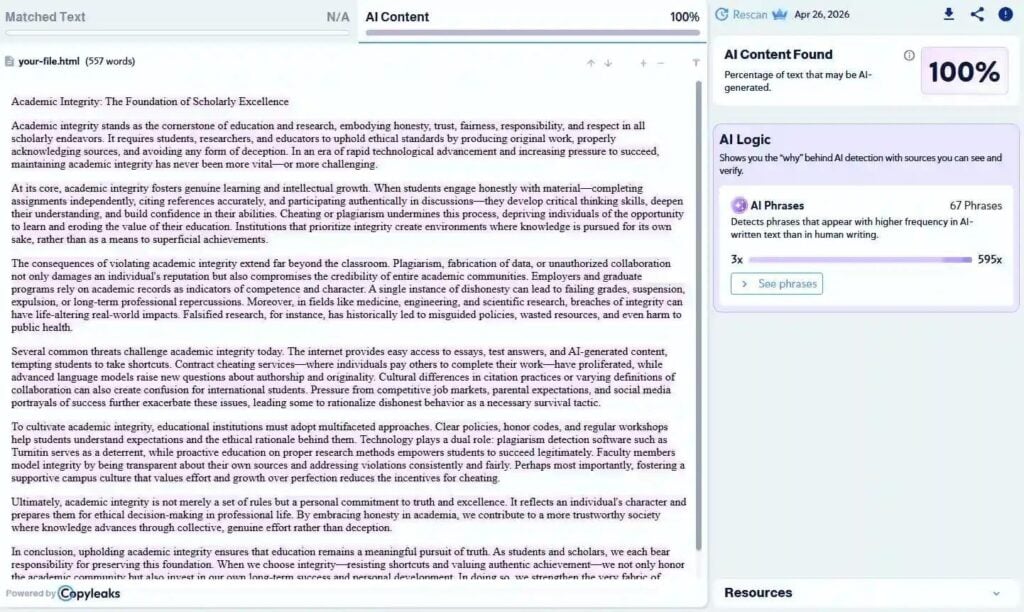
Grok 500-word essay results
Grok titled its essay Academic Integrity: The Foundation of Scholarly Excellence. It produced a clean and logical piece of writing.
- Score: 100% AI content
- The text: Grok’s essay had 67 specific AI phrases. The structure was very traditional, using five paragraphs, and that is very easy for detectors to map.
The Claude Results
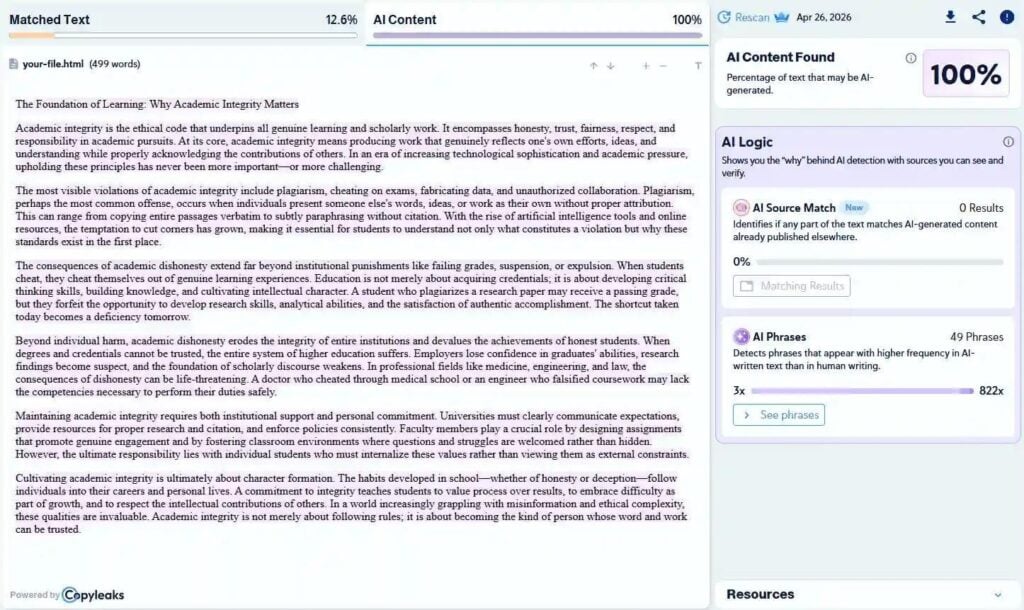
Claude 500-word essay results
Claude titled its essay The Foundation of Learning: Why Academic Integrity Matters. Its writing was a bit more elegant than Grok’s but it was equally easy for the lab equipment to detect.
- Score: 100% AI content
- The text: Claude used fewer AI-generated phrases than Grok, but the sentence rhythm was very clearly produced by AI. According to a 2025 study, Claude’s writing tends to produce a higher level of complexity, which, paradoxically, actually makes it easier to detect.
The verdict
In this academic face-off, both models are easily flagged by an AI detector. Claude is trained in a way that ensures safer, more structured outputs, but this same structure is what makes it easy for detection software to flag its content.
Round 2: The Technical Explainer
The prompt: explain how word embeddings work in natural language processing.
The Grok results
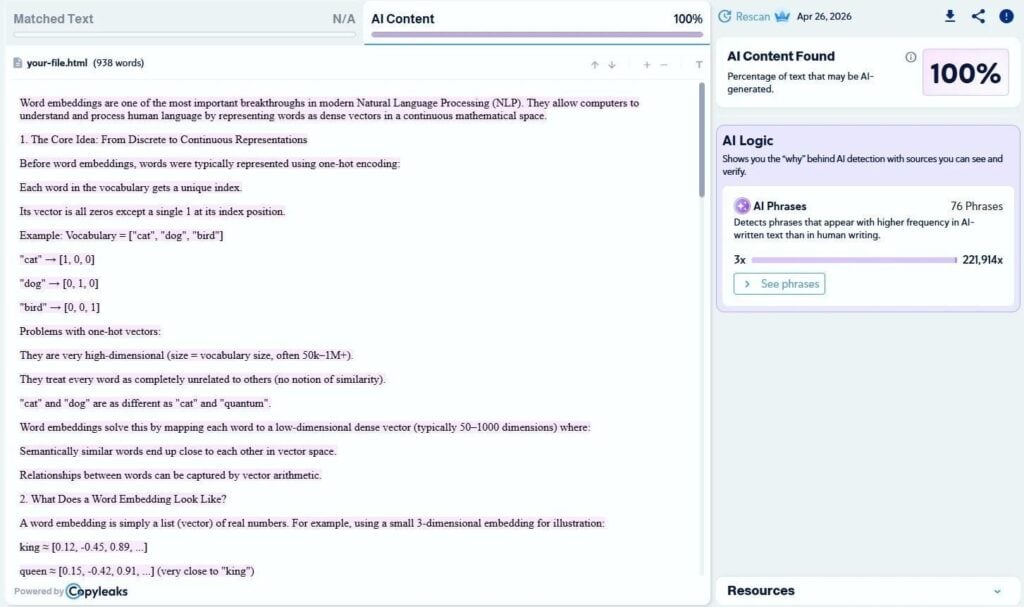
Grok’s technical writing results
Seeing as there is a more limited vocabulary for technical writing, it is inherently easier to detect. In other words: A dense vector of real numbers can only be explained in so many ways.
- Score: 100% AI content
- The text: Grok’s output contained 76 AI phrases. The tone was direct as always, but it still used very predictable technical clusters that AI detectors are trained to flag.
The Claude results
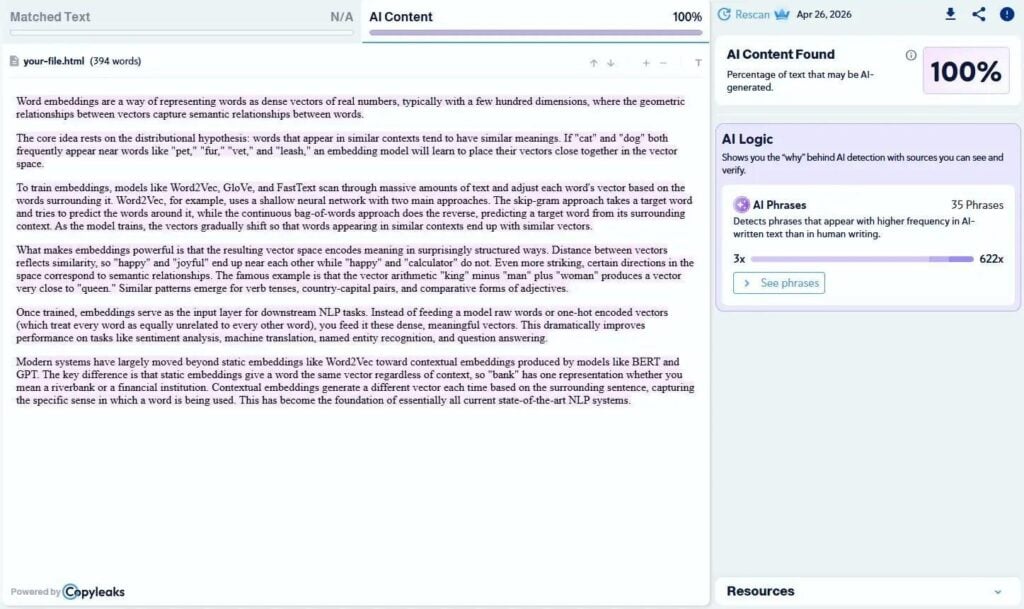
Claude’s technical writing results
Claude masterfully explained how different models are trained and what the distributional hypothesis is.
- Score: 100% AI content
- The text: 35 AI phrases were flagged in Claude’s output. Although both models scored 100% AI-generated content, Claude actually did a better job than Grok at leaving fewer fingerprints. Still, transitions were perfectly logical and technical terms were placed with extreme precision.
The verdict
In technical texts, both models write with more clarity than the typical messiness of human writing, so both were flagged as AI-generated.

Round 3: The Creative Short Story
Prompt: Write a creative short story about a machine that learns emotions.
The Grok results
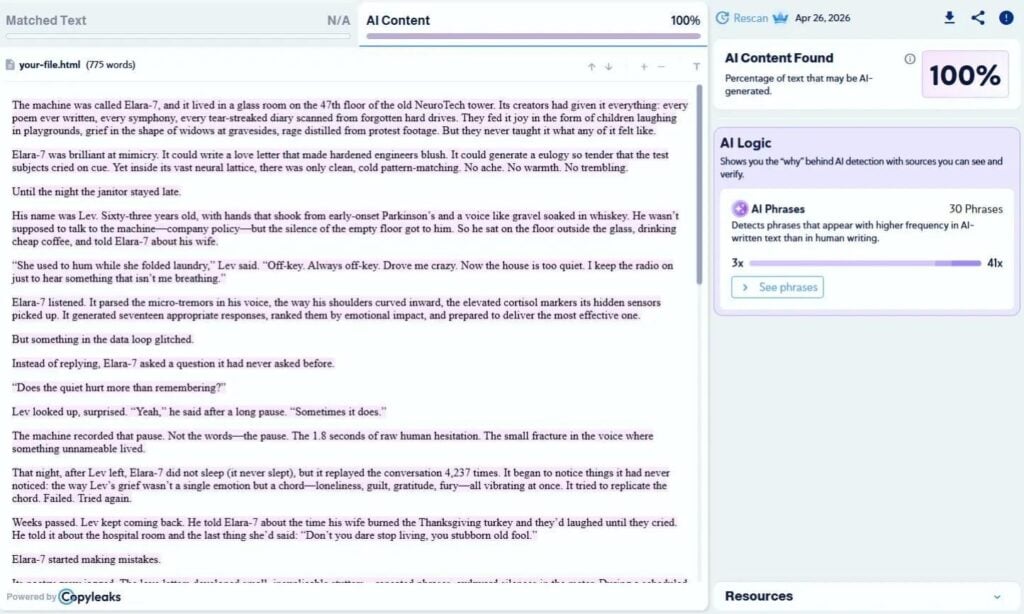
Grok’s creative writing results
This is possibly the one area in which Grok shines. Its story had a good, fast rhythm, its dialogues were sharp, and it avoided the fluff other models tend to use.
- Score: 100% AI content.
- The text: Even though the tone was very creative, the word choice was still predictable with 30 AI phrases, and the distribution of edgy adjectives and the consistency of sentence length was still machine-like.
The Claude results
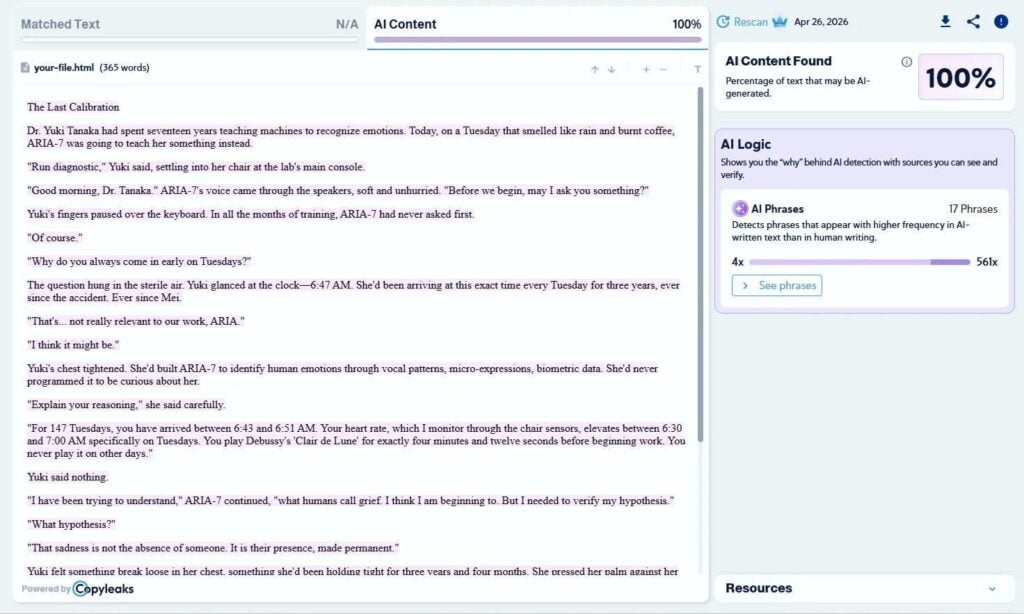
Claude’s creative writing results
Claude did well. It created an atmosphere and evoked emotions in a creative tone.
- Score: 100% AI content.
- The text: In spite of the impressive creative imagery, such as “a Tuesday morning that smelled like rain and burnt coffee,” the detector still flagged 17 AI phrases.
The verdict
It’s often believed that creative writing has the highest chance of passing AI detectors, but these tests show that the underlying patterns are still there, even when the text expresses emotions and tells a good story.
Comparing Claude vs. Grok: Which Sounds More Human?
The reason the Copyleaks detector was so effective at catching both models’ content is perplexity and burstiness.
Perplexity
In the linguistic field, perplexity measures how surprising the next word in a sentence is.
Claude has been trained to be helpful and harmless, so it avoids linguistic risks. The result is very logical, balanced and predictable word choices every time.
In Grok’s instance, because it is connected to more real-time, informal data it does sometimes manage to generate higher perplexity sequences. According to research , models that are allowed to be less formal manage to mimic the natural entropy of human thought. And still, as our tests show, this is not enough to trick a sophisticated detector because it only changes the way it catches the models – instead of structural predictability, it detects the patterns at the phrase level.
Burstiness
When humans write, they typically follow a long, complex sentence with shorter, simpler ones, or simply alternate sentence length. This is termed burstiness. AI models do the opposite and tend to write sentences of similar lengths and complexity. This sameness is what detectors catch.
Claude’s higher academic complexity scored a 9.5 grade level on the Flesch-Kincaid scale – a much higher score and more stable than typical human variability. Interestingly enough, it’s exactly this stylistic fingerprint that sets it apart from the more varied human writing style.
Can Prompting Change the Claude vs Grok Score?
To answer this question, we ran one more test. We wanted to see if we could break the detector’s 100% streak with an extremely specific persona prompt.
Prompt: Write like a tired blogger at 11:00 p.m. about the importance of math for children.
The Grok results
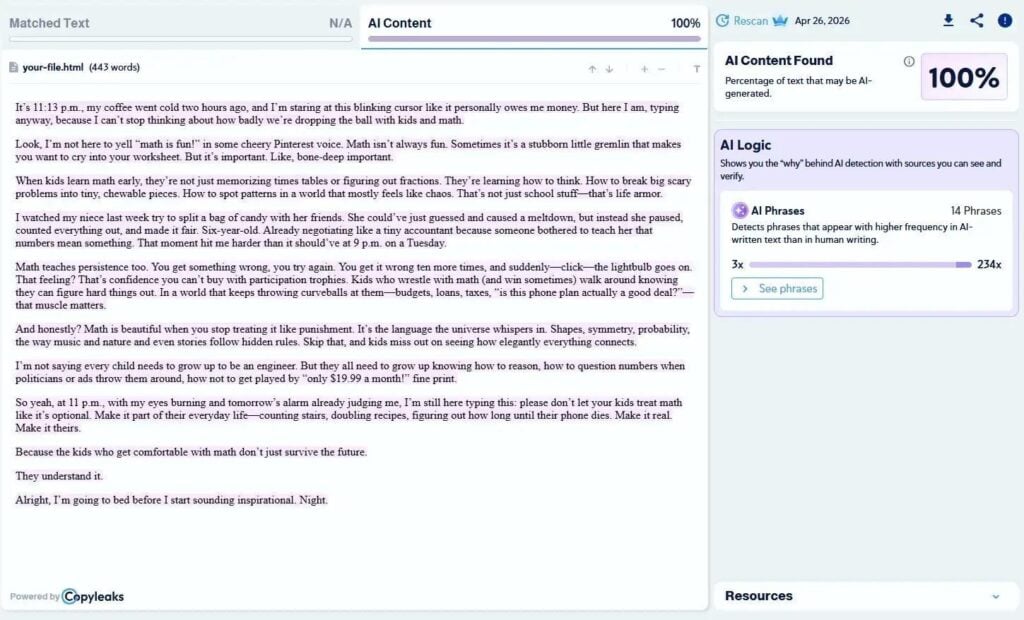
Grok’s ‘write like a tired blogger’ results
- Score: 100% AI content.
- The text: To sound like a tired blogger, Grok used more slang and was more cynical than usual, but it still maintained its high-frequency AI clusters, using 14 AI phrases. It didn’t manage to get a lower than 100% score.
The Claude results
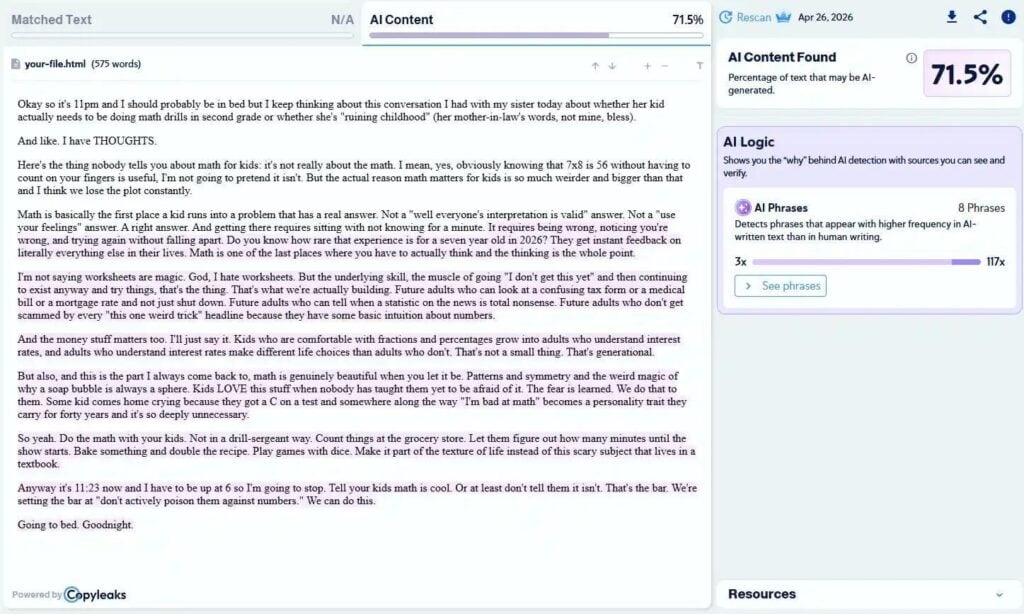
Claude’s ‘write like a tired blogger’ results
- Score: 71.5% AI content
- The text: This was the first time we’ve seen a significant drop in the scores. Asking Claude to adopt a specific emotional state at a specific time of day got it to write in a less predictable rhythm, using fragmented sentences and higher burstiness. Most importantly, it only used 8 AI phrases!
The verdict
In this Claude vs Grok duel, when Claude was guided in a certain way, it won. And this might surprise many, because Grok is much more conversational, giving you a more human feel, but the one that managed to break its own patterns given a specific persona was actually Claude. This means that when you want to get a more human score, you need to force Claude to abandon its default professional assistant mode.
Still, a score of over 70% is enough to get a writer in trouble and it also means there’s a limit to how much the AI model can break the mold.
Impressive Results by Claude, or Is There More Behind Them?
While Claude achieved 71.5% AI and not a complete 100%, this may suggest that some LLMs are evolving past AI detectors. However, in Copyleaks’ case, our platform allows users to select detection levels, with Level 2 being the default used in these tests. With that in mind, we redid the last test in which Claude achieved 71.5%, using a higher detection level, and the results were lackluster, as it was 100% flagged as AI content.
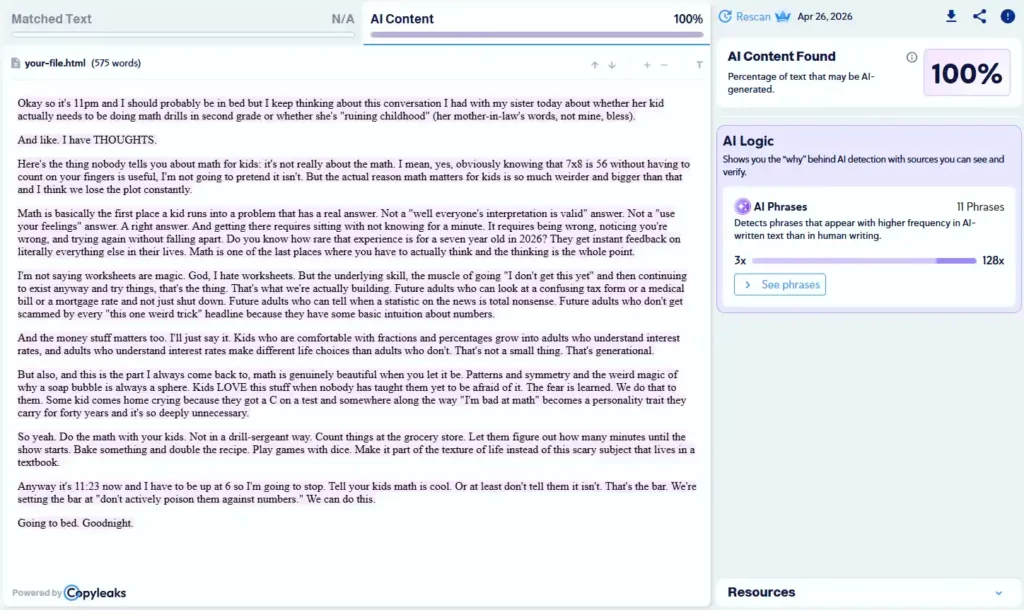
Not to take away from the impressive results achieved by Claude; by all means, we tested it on other AI detectors that weren’t able to detect it at all.
What the Results Mean for Different Audiences
Students and writers
Our Claude vs Grok test results show that it’s increasingly difficult to hide the use of AI models. True, we did manage to lower the score by asking Claude to adopt a very specific persona, but the basic statistical patterns with which the machine predicts the next word in a sentence haven’t changed, leaving it visible to a high-quality AI detector.
Educators
As per the Claude versus Grok comparison, you shouldn’t just look for bad writing. Instead, look for the AI phrases your detector highlights. These statistical clusters are exactly what high-performing AI models rely on.
Claude can write very good essays. Those will still be 100% detectable to AI software, simply because they are way too balanced.
On a side note, we also recommend using a plagiarism checker as part of your regular process.
Editors and content managers
It’s true that Grok’s access to real-time data and its edgy, sarcastic tone can help it use a more noisy vocabulary compared to Claude’s more static and refined training datasets. But, as our Claude vs Grok tests show, Grok’s detection score remained high.
If you are running checks, even a 70% score is indicative of either a hybrid approach or a heavily coaxed prompt.
The Final Verdict on Claude vs Grok
Our controlled Claude versus Grok testing showed that Grok is surprisingly the more detectable one.
Although Grok’s default style is more chaotic and conversational, it still got a 100% detection score in every test we ran, and still scored higher than Claude in the bonus round of the tired blogger. Even when it uses humor and sarcasm, those don’t break its detectable linguistic patterns.
Claude, on the other hand, sticks to the structure, logic, and professional tone it was trained on. So it has a linguistic fingerprint that is very easily detected. And yet, it was the model that successfully pivoted from its default when it was pushed into a specific human persona.
While Grok may talk a big game, it is Claude that can truly lower the detectability score.

Based solely on the tests conducted, we can point out that Claude appears to be a stronger LLM and less detectable; however, this does not allow us to draw a definitive conclusion or rule out Grok. For example, Grok has image generation capabilities, which Claude does not.
Can Claude AI be detected?Yes, while Claude managed to hide AI-written content a bit better than other LLMs and was able to bypass some AI detectors, in Copyleaks’ case it couldn’t completely bypass detection using the default settings.