Passive to Active Voice Converter: How to Use One – and What It Can’t Hide
Historically, passive voice has been used to give texts a more formal or objective style. Interestingly enough, it has now evolved into a red flag in the realm of digital content. The main reason for this evolution: generative AI tools use the passive voice much more than human writers do. As a result, the internet is flooded with passive-voice content.
To counteract that swing of the pendulum, there has been a surge in tools that convert active to passive voice. The primary users of these tools can be divided into two separate groups: writers who want to improve or sharpen the content they create, and those trying to trick AI detection tools so that their text passes as a human creation.
No matter which group you subscribe to, it can be very useful to understand how a passive to active voice converter actually works, and in which scenarios using those tools can be an advantage, rather than a red flag.
More specifically, getting to know voice converter mechanics can help you understand:
- Whether the tool harms the integrity of AI detection processes
- If such a converter improves passive-heavy content
- How voice construction impacts writing quality
- How voice choice affects the pattern of AI signals
What is a Passive to Active Voice Converter
Let’s start with a quick definition of the two voices:
- In passive voice, the subject of a sentence receives the action of the verb. For example: The article (subject) was written (passive verb) by a journalist.
- In active voice, the subject of a sentence performs the action of the verb. For example: The journalist (subject) wrote (active verb) the article.
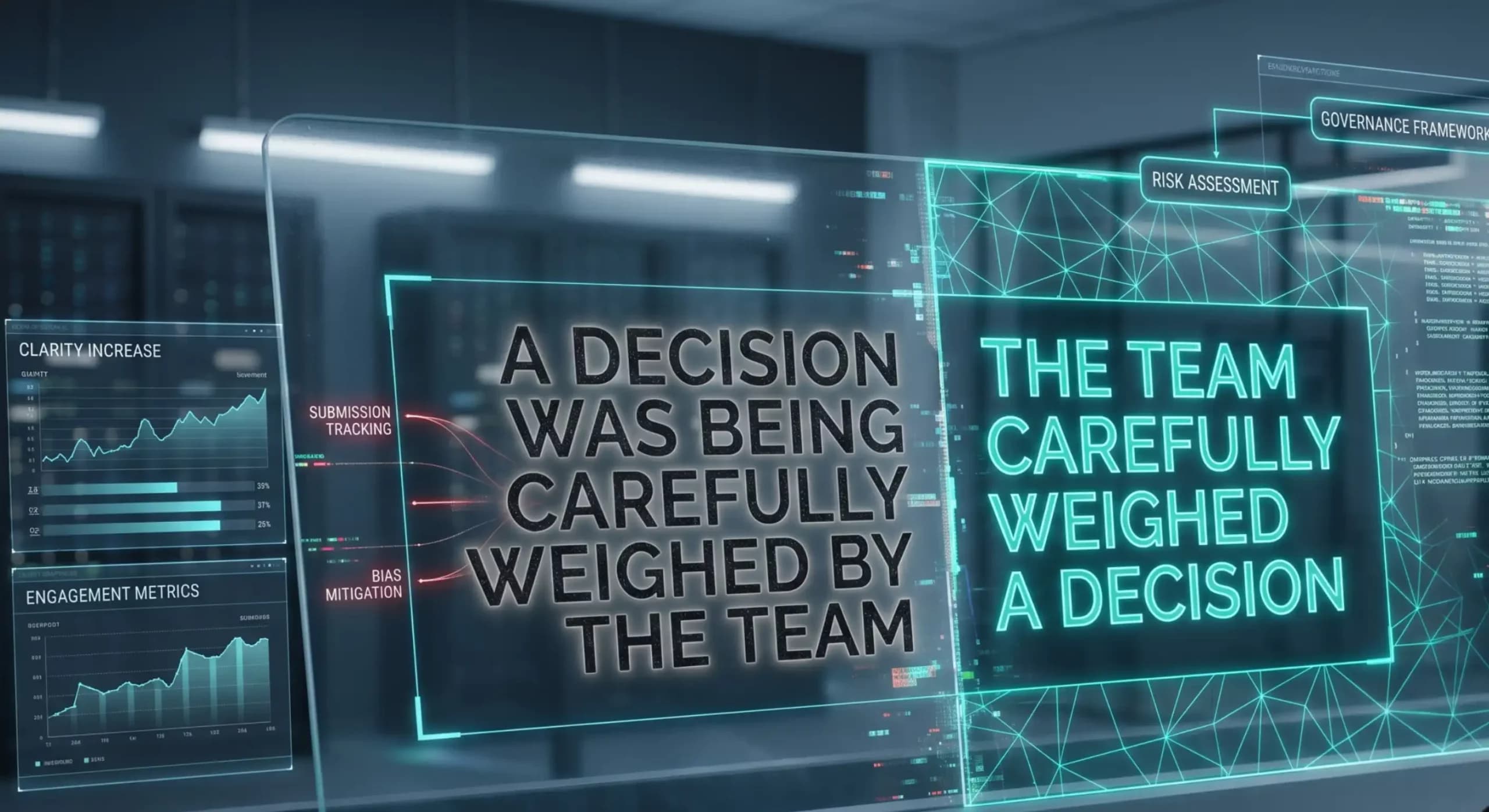
Essentially, a passive to active voice converter reorders the content linguistically. It identifies the structure of the object (the decision) + a form of the verb “to be” (has been) + a past participle (made) + an optional “by” phrase (by the board). Then, it reverses the order so that the agent – the person or thing doing the action – becomes the subject, and adjusts the rest of the elements to match. In our example, “The decision has been made by the board” becomes: “The board has made the decision.”
But, it’s not as simple as that for software. The fact is, many sentences don’t have an agent. In plainer words, many sentences don’t directly say who performs the action. For example, “Errors were made,” or “Steps have been taken.” To handle such cases, a converter must either assume what the subject is, or flag the sentence as incomplete. This exact point is what makes it easy to distinguish between high- and low-quality tools: the former highlights such instances for manual review while the latter typically makes an uncalculated guess that completely ruins the meaning of the sentence.
(When) to Convert or Not Convert, That Is the Question
The only text types for which the advice to always use active voice is practical are technical and legal writing. For any other type, it’s a myth – professional writing included. For writing to be of high quality, it requires nuance, and in many instances, that means the correct choice is passive voice.
Let’s look at some specific examples.
- Scientific writing
In this field, because the process tends to be more important than the people who execute it, using active voice would only add unnecessary information. “The samples were heated to 180°C” is much more appropriate than “The researchers heated the samples to 180°C.”
- Legal documents
Passive voice is used here because it helps convey the all-important impartiality. “The agreement shall be governed by the laws of the jurisdiction” is impartial, while “the laws of the jurisdiction shall govern the agreement” gives the laws an active role that feels almost aggressive rather than like an objective standard.
- An unknown agent
When it is unknown who or what did the action, there’s no way to phrase an active sentence. “Three students were accused of academic misconduct” cannot become active unless you invent the agent: “the professor accused three students of academic misconduct” might be true or false.
A passive to active converter isn’t meant to completely eliminate every passive sentence but to convert the unintentional ones. This means intentionality is the actual goal: passive voice should only be used when it serves the sentence well and not because it seems easier.

The Reason AI Writing is Passive
AI tools use passive voice not because it is a human-like stylistic preference, but because those are the datasets they were trained on.
Large Language Models (LLMs) are trained using huge amounts of formal text, like government publications, academic journals, and corporate reports. What all these texts have in common is a heavy use of passive voice. As LLMs were trained on such a high density of passive voice, it is only natural they consider that to be the statistically safe route to take and this means they tend to prefer statistical safety over a stylistic tone. While they may come off as authoritative and neutral, they mainly just avoid sounding opinionated.
All this is backed by a large volume of research.
- 2024 research analyzed the different human and machine-generated linguistic patterns in news texts. The researchers found that while LLMs’ texts are fluent, they also have a distinct “preference for parts of speech displaying (a sense of) objectivity” and that they arrange sentences (syntactic structures) differently than humans. The research also concluded that LLMs “have a tendency to use more auxiliary verbs and verb phrases”, which are the main components of passive voice, and use significantly fewer adjectives than humans.
- Another 2024 research analyzed the linguistic signatures of LLMs and found that they lack syntactic complexity, or simply put: their writing is a bit flat. The researchers stated that LLM-generated text contains a higher density of passive voice, as well as significantly higher usage of numbers, than texts written by humans. They added that “the passive voice creates statements that appear detached from interest, intention, or ideology.”
- A comprehensive review from 2025 states that passive voice is a linguistic feature distinguishing AI from human writing. The researchers noted that AI has “a more objective and structured writing style” that’s defined by stylistic uniformity. They added that because AI has no “diverse rhetorical devices,” it tends to use passive voice, creating a predictable pattern detectors can identify as machine-generated content.
Can You Disguise AI-Generated Content by Using a Passive to Active Voice Converter?
From everything we’ve said so far, it stands to reason that if AI relies heavily on passive voice, then converting passive to active voice should help avoid detection. Instead of looking for the answer elsewhere, we decided to test this assumption ourselves.
The methodology
- We ran the original AI-generated passage through the Copyleaks AI content detector.
- We ran the same passage through a passive to active voice converter, making sure every single sentence was changed to active voice without making any other changes.
- We ran the converted version through the Copyleaks detector.
The results
The short version: changing the voice from passive to active has an insignificant effect on the ability of a high-quality detector to flag AI.
More specifically:
| Voice | Detection score | AI-generated phrase count |
| Passive – the original version | 100% AI | 38 |
| Active – the converted version | 100% AI | 42 |
The analysis
The passive to active converter basically changed the order of the words and the verb form, but it had no impact on the underlying patterns that detectors are trained to find. These include:
- Perplexity: a factor measuring how statistically predictable the word choices and sequences in the text are. AI typically chooses the next most probable word and the conversion doesn’t change the words that were chosen, only their order and the verb form.
- Burstiness: a factor that measures sentence length and the structural complexity of the text. AI tends to use the same rhythm and similar sentence length, while humans vary those. Simply reordering the subject and object doesn’t change that.
- Lexical patterns: the phrasing, language and constructions AI uses – such as “it’s worth noting,” “in today’s digital world, and so on – don’t change after conversion.
The bottom line
Anyone who runs an AI-generated text through a passive to active voice converter won’t make it harder to detect. The specific signals an AI content detector analyzes are not affected by the voice choice, as it is just one component among many.

How to Use a Passive to Active Voice Converter Effectively
The passive to active voice converter should be treated as an editing assistant rather than a tool to outsmart detection.
Here are a few rules that will help you use this tool the right way:
- Run full drafts through it. Giving the tool the full context helps it make better suggestions.
- Don’t follow it blindly. Even converters can make mistakes, so review every suggestion and decide if it’s the right call.
- First write the entire piece, then use the tool. Your ideas should flow freely, and knowing you have a tool that can improve and sharpen your text when you’re done should free you from any indecisiveness.
- Don’t overdo it. Natural human writing has a rhythm. It tends to move between long, medium, and short sentences, so don’t let the tool make the text sound monotone and mechanical by converting the entire piece to active voice.
- Pay attention to other elements. Voice is only one aspect of writing. Don’t forget to also pay attention to other aspects, like clarity and tone.