Q&A: Copyleaks CEO Alon Yamin on AI’s Role in the 2026 Midterm Elections
This interview was conducted ahead of Election Day on November 3, 2026.
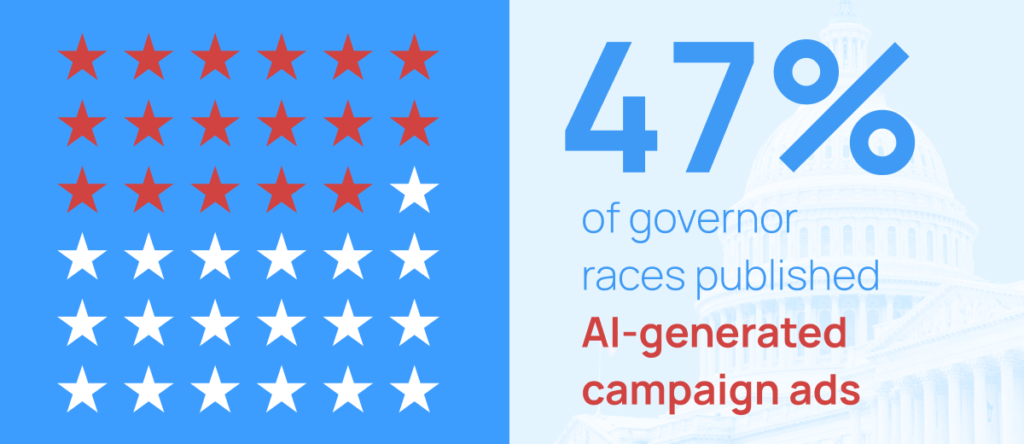
AI in political ads played a visible role in the 2026 midterms. A new Copyleaks analysis found that nearly half (47%) of the 36 gubernatorial races on the 2026 ballot featured generative AI ad creative, including cloned voices, manipulated likenesses, and AI-generated videos.
In the Q&A below, Copyleaks CEO and Co-Founder Alon Yamin discusses how campaigns across the political landscape are using generative AI, what voters should look for when evaluating these ads, and how AI is influencing the midterm elections.
Q: Does the use of AI in political ads really matter, or is it just another tool for creating campaign content?
Alon: At the end of the day, AI is just another tool. It lets political campaigns create, hopefully, high-quality content faster, more efficiently, and at scale. There’s nothing inherently wrong with that.
The challenge, however, is transparency. Some states have disclosure requirements around AI use in political ads, particularly when it involves depictions of humans. Deepfakes of candidates are especially problematic. If a campaign uses AI to make an opposing candidate, for example, appear to say or do something they never actually did, that can be misleading.
In my view, voters deserve to know when the content they’re seeing has been AI-generated or manipulated. Either through a first-party disclosure or, at the very least, downstream via a third-party tool like ours.
Q: If campaigns aren’t transparent about their use of AI, how can voters spot AI-generated or manipulated political ads?
Alon: AI-generated content is increasingly difficult to identify from “real” content, but there are some best practices and warning signs voters can keep in mind.
Pay attention to visual inconsistencies, for example, like flickering, unnatural facial expressions, distorted features or unusual movements. Listen for audio anomalies, like robotic speech, unnatural pauses or bad synchronization between someone’s lips and their speech. Some AI images also have a distinctive, overly polished appearance. (Think AI-generated restaurant or festival flyers, as an example.)
It’s also important to consider the source. If something seems particularly outrageous, take a moment to verify it. Voters can also use AI detection tools like ours to analyze suspicious images, audio, video or text.
Book a free consultation with an AI Detection expert
Q: Are you seeing any political differences in how AI is being used? Is one party using it more than the other?
Alon: No. Based on our analysis, AI is being used in political ads across both sides of the aisle. Depending on the race, one party may be using it more aggressively than another, but this isn’t a phenomenon limited to Republicans or Democrats.
Q: Beyond political attack ads, how else is AI influencing the midterm elections?
Alon: One interesting development, at least to me, is around data centers. Opposition to these facilities is becoming a major election issue. An NBC News Decision Desk poll found that 69% of respondents oppose building AI data centers in their areas. Some of that opposition may also reflect broader frustration with AI, including the AI-generated content voters encounter online. But concerns about data centers’ energy and water use, and whether the jobs they create justify those costs, are also driving the debate.