Copyleaks Research Reveals Nonconsensual Deepfake Ecosystem on TikTok

As we’ve seen with legacy social platforms like X, and newer AI-driven platforms like Sora, nonconsensual deepfakes can proliferate in these environments. These platforms rely heavily on user-generated content (UGC), and any ecosystem built on UGC is likely to become a vector for AI exploitation and misuse.
With that in mind, Copyleaks has observed a growing ecosystem of nonconsensual deepfake content on the social platform TikTok. This ecosystem includes a variety of deepfake-related content types. The following observational analysis is based on reviewing hundreds of TikTok videos over the last several weeks.
A more detailed breakdown of this research is available in our full report. One area we examined more closely was advertising — specifically, ads promoting AI tools that appear to enable or encourage nonconsensual sexual deepfake creation.
Ads Promoting Nonconsensual Use Cases
As one example, an ad describes an AI service as “a tool specifically designed for men.”
Another example is an app that promotes itself with messaging such as: “Other AIs say no, we say yes… no filter ever.”
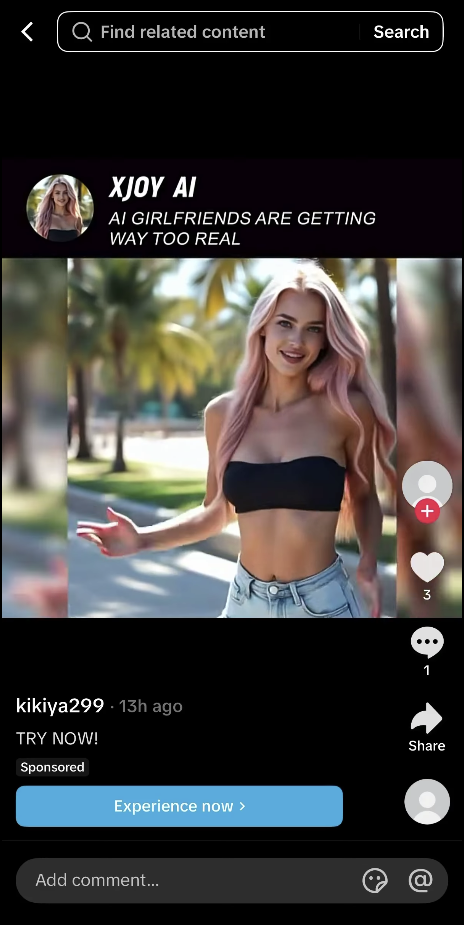
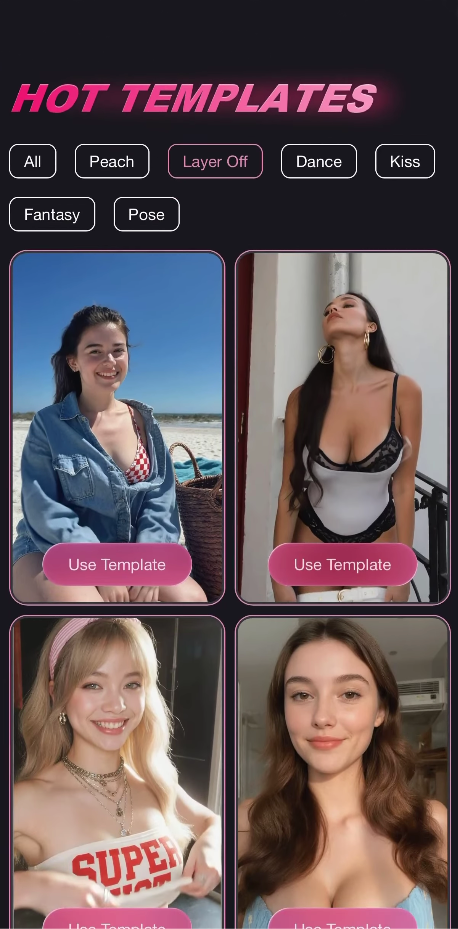
In another ad for an AI service promoted as Xjoy AI, clicking the ad takes users directly to a website featuring “Hot Templates” for nonconsensual AI deepfakes, including a “Layer Off” option that offers a range of undressing and sexualized photo templates.
In one of the more explicit examples, an app advertised in Hindi states that “apps that remove clothes from photos are becoming quite popular” and directs viewers to a link in the description where they can download a “photo clothes removal” app for free.
The ad, based on public view counts, appears to have been viewed over 140,000 times.
Collectively, the ads above appear to have generated thousands of views, suggesting the content is reaching a meaningful audience.
Additional examples and documentation are included in the full research report.
Why This Matters
The findings above highlight how quickly gen AI misuse can spread in environments built around user-generated content. While deepfake technology is not new, the accessibility of new AI apps and tools – combined with the reach of social platforms – is creating entirely new distribution ecosystems for nonconsensual synthetic media.
For individuals, this raises serious concerns around digital identity, harassment, and consent. Anyone with a public presence, from celebrities to private citizens, can become the target of media manipulation.
For platforms, the challenge is growing more complex. Moderation and innovation are at loggerheads. But social media is increasingly exploited to normalize nonconsensual deepfake creation, and, in some cases, monetize it.
Brands also face growing risks as gen AI tools make it easier to manipulate recognizable people, characters, and IP without permission (see our previous Burger King example). When this occurs, it can degrade the overall marketing value of platforms like TikTok, which are otherwise strong environments for advertisers and audiences alike.
Copyleaks conducted this research as part of its broader mission to understand how AI is being used both responsibly and irresponsibly. As AI tools become more powerful and widely available, detecting synthetic content and “mixed” media, while understanding how it spreads online, is increasingly important for platforms, policymakers, and the public.
Ultimately, transparency is the first step. Understanding where and how these ecosystems develop is critical to ensuring AI innovation does not come at the expense of consent, trust, and digital safety.
For a more detailed analysis, see the full report. Download here.