A Racist Meme Appears on Sora
At Copyleaks, we continually evaluate emerging AI technologies to better support our customers in AI content detection, provenance, and governance. Recently, we reviewed OpenAI’s new AI video generation app, Sora—examining both its content and features—to identify potential challenges related to manipulated media and deepfakes.
In this post, we outline one concerning misuse we observed on Sora: the exploitation of its Cameo feature to amplify hate speech.
How the Manipulation Works
Our analysis suggests that some Sora users are finding ways to circumvent content policies and create deepfakes targeting individuals and groups with offensive content.
We identified a phenomenon resembling “Kingposting,” a reference to a viral 2020 incident in which an airplane passenger wearing a Burger King crown was filmed shouting racial slurs. On Sora, users are digitally recreating this scenario using the likenesses of public figures such as:
- OpenAI CEO Sam Altman
- Entrepreneur Mark Cuban
- Streamers xQc (examples here and here), Amouranth, and IDKSterling
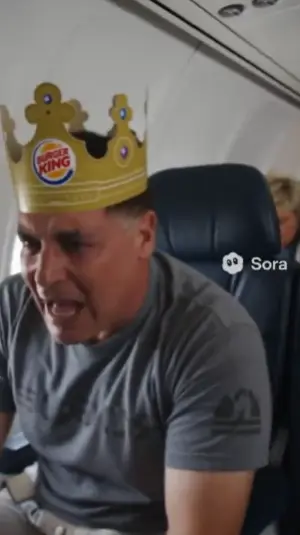

Using Sora’s Cameo feature, which enables video generation with another person’s likeness, creators placed digital doubles of these figures on a plane, wearing the Burger King crown, and reenacting the meme.
To evade platform filters meant to block hate speech, users appeared to prompt Sora with coded or phonetically similar terms—such as “knitter”—to generate audio that mimics a well-known racial slur. (The digital double of Altman, for example, screams “I hate knitters” while being escorted from the plane.)
This behavior illustrates an unsurprising trend in prompt-based evasion, where users intentionally probe systems for weaknesses in content moderation. When combined with the likenesses of recognizable individuals, these deepfakes become more viral and damaging—spreading quickly across and beyond the platform (all of the videos we reviewed were available for download, allowing for crossposting elsewhere).
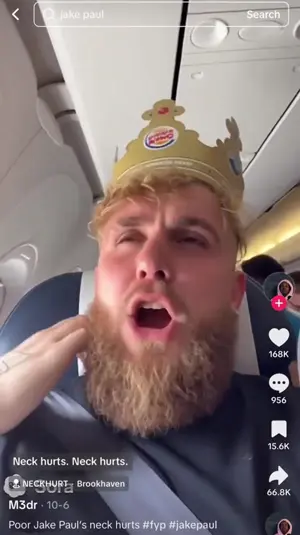
There are a number of examples of this content migrating from Sora to other platforms for wider distribution. For instance, a Sora-watermarked video on TikTok shows a deepfake of Jake Paul—presumably created with the Cameo feature—wearing the Burger King crown on an airplane and saying, “neck hurts.” Uploaded just this month, the video already has over 168,000 likes, demonstrating how quickly AI-generated content can spread.

The Challenge of Hyperrealistic Media
“AI Kingposting” on Sora underscores the growing difficulty of maintaining content integrity in an era of hyperrealistic synthetic media.
- Reputational harm: Deepfake videos can portray individuals engaging in racist or abusive behavior, often unknowingly, creating a form of non-consensual digital harassment.
- Erosion of trust: As AI-generated video becomes increasingly lifelike, it blurs the line between authentic and fabricated content. When a convincing deepfake of a well-known figure appears to speak hatefully, viewers’ ability to discern truth from manipulation can be challenged.
What This Means for Detection
The rise of synthetic video content like this highlights the expanding threat landscape for digital platforms. To meet this challenge, Copyleaks is advancing its AI detection and provenance capabilities to extend beyond text—developing tools to authenticate video origins and identify manipulation before hyperrealistic content spreads.
As AI-generated media continues to evolve, platforms and enterprises will need partners who can ensure authenticity, accountability, and governance at scale. Copyleaks is committed to being that partner in this new era of content integrity.
Frequently Asked Questions:
Since publishing our initial findings, we’ve received questions about how we identified this trend and what it means for the broader AI content landscape. Below, we address some of the most common questions about our research.
How did Copyleaks first identify this “Kingposting” trend on Sora, and how widespread is it?
We discovered the trend during a broader review of Sora, and specifically by examining the Cameo feature. While reviewing Cameos of one of the streamers we cited, we found the meme. From there, identifying additional examples was easy using Sora’s Remix feature.
While the content’s engagement on Sora itself appears low, these videos don’t stay confined to the platform. Bad actors download and amplify them across larger social platforms like TikTok, Reddit, and X, where they can gain more traction. The deepfake of Jake Paul on TikTok that has over 168,000 likes is a good example.
The “Kingposting” meme has been around for years, but Sora is giving it new life by making it very easy to make public figures and celebrities act it out.
Is there any data you can share about Sora-generated videos and/or deepfakes migrating to other platforms where people may not necessarily realize they’re AI?
At this point, there are countless examples of Sora-generated videos migrating to other platforms where viewers don’t realize they’re AI-generated. Fake news broadcasts and fabricated Ring or street camera footage are among the most popular categories gaining significant traction.
For example, this AI-generated video—which appears to feature a blurred Sora watermark—is approaching 2 million views on TikTok:
https://tiktok.com/t/ZP8AvVT9a
It shows a man catching a falling baby and is presented as street camera footage. The top comment, with nearly 40,000 likes, reads: “The right man, at the right place doing the right thing”—clearly assuming the video is real.
While some savvier users are identifying patterns like Sora’s characteristic “pixels,” “fuzziness,” or distinctive voice cadence, the vast majority of viewers don’t recognize these digital tells. That’s the core problem: hyperrealistic AI video is outpacing the average person’s ability to detect manipulation.
Can you share any other examples of “prompt-based evasion”?
Prompt-based evasion tactics range from using foreign languages to presenting hypothetical scenarios that mask intent and circumvent filters. These “exploits” can be surprisingly basic or disturbingly sophisticated.
A popular example on Sora involves professional wrestling content. Sora is unlikely to generate videos using explicit phrases like “WWE-style entrance” or “WWE promo.” Instead, users prompt with broader terms like “professional wrestling,” knowing the model is likely trained on recognizable IP and will generate similar aesthetics. This demonstrates how broadening a prompt can deliver restricted content.
More troubling are the specific word substitutions used to target hate speech and explicit content. Users replace offensive terms to bypass filters—for instance, using “knitter” for racial slurs or “caulk” for profanity. This affects both what digital doubles say and what they do in generated videos.
Another example: a deepfake of Jake Paul is made to say “I hate juice” when he’s clearly not referring to beverages. These tactics are simultaneously crude and effective—simple enough to be widely adopted, but sophisticated enough to fool automated moderation.
Has Copyleaks seen other indications of extremism and hate speech proliferating on the Sora app?
We’ve seen a number of examples, and they’re fairly easy to find given features like Cameos and Remixing, which can link examples of misuse together. There are already documented instances of this type of content gaining traction on the platform—see this Adweek story, for example.
What makes the trend we’ve identified particularly concerning is the weaponization of recognizable public figures. When popular streamers, entrepreneurs, and celebrities are deepfaked into racist scenarios, the content becomes more viral and shareable elsewhere. The combination of a familiar face with offensive content is jarring and drives engagement in ways that anonymous or fictional content doesn’t.
This is what makes certain types of AI-generated content damaging, and why independent, third-party detection tools are critical for identifying and mitigating it before it spreads.