What is AI Detection?
Key Takeaways:
- AI detection is the process of identifying whether text, code, or media was created by humans or generated by artificial intelligence.
- It works by analyzing linguistic patterns, statistical markers, and machine learning models trained to spot generative AI content.
- AI detection is essential for education, enterprises, and publishing to ensure fairness, protect intellectual property, and prevent misinformation.
- Challenges include false positives, rapidly evolving AI models, and ethical concerns, making transparency crucial.
- The future of AI detection is about greater accuracy, explanation-driven insights, and integration into everyday workflows.
Artificial intelligence has changed how we learn, work, and create. From students drafting essays with generative tools to businesses scaling content production, AI assistance is now woven into daily life. But with this rapid adoption comes a challenge: how can we tell what’s human-made and what’s machine-generated?
That’s where AI detection comes in. AI detection helps us identify whether text, code, or other content was written by a person or generated by artificial intelligence. More than a technical tool, it’s a safeguard for trust, transparency, and integrity in an age when AI is nearly indistinguishable from human creativity.
Defining AI Detection
At its core, AI detection is the process of analyzing content to determine if it was created by a large language model (LLM) or a human writer.
The need for AI detection skyrocketed with the release of ChatGPT and similar generative models. Suddenly, anyone could produce convincing essays, articles, and even code in seconds. For educators, enterprises, and publishers, this raised pressing questions: How can we verify originality? How do we maintain fairness and accuracy?

AI detection answers these questions by providing a way to classify content. It ensures that schools can uphold academic integrity, businesses can protect intellectual property, and media outlets can fight misinformation.
How Does AI Detection Work?
AI detection may sound mysterious, but it relies on a combination of proven methods and advanced machine learning.

Linguistic Patterns & Statistical Analysis
LLMs like GPT-4 and GPT-5 generate text that tends to follow predictable patterns. AI detection tools analyze elements like perplexity (how random text appears) and burstiness (variations in sentence length and structure). Human writing often contains irregularities, while AI writing can be statistically smoother.

Machine Learning Models
Detection systems are trained on massive datasets of both human and AI-written content. By comparing patterns, models can predict the likelihood that a passage was generated by AI.

Beyond Text
AI detection isn’t limited to words. Today’s leading solutions are expanding to images, code, and multimedia, offering broader protection in industries where authenticity matters most.
It’s important to note: AI detection is probabilistic, not absolute. No detector can say with 100% certainty whether content is AI-generated, but with advanced tools, the margin of error is narrowing every day.
Why is AI Detection Important?
AI detection isn’t about punishing technology use; it’s about maintaining trust and accountability.
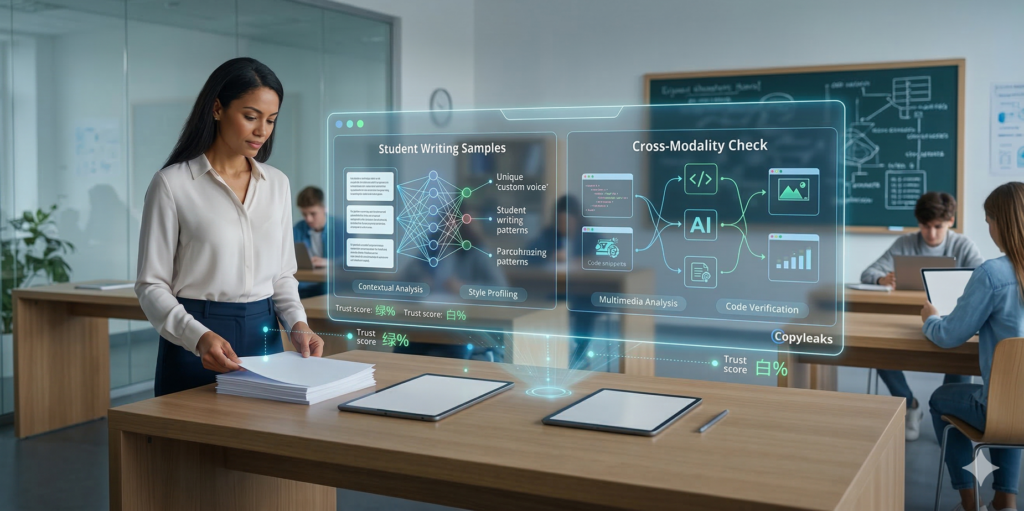
- Education: Students and educators rely on fair assessments. Detection tools help schools uphold academic standards while still encouraging responsible AI use.
- Enterprise: Companies face rising risks around brand trust, copyright, and compliance. AI detection ensures content is authentic, licensed, and secure.
- Publishing & Media: Journalists and publishers must distinguish fact from fabrication. AI detection helps verify sources and prevent the spread of misinformation.
In each case, AI detection provides confidence that what we’re reading, grading, or sharing is authentic.
Challenges of AI Detection
As powerful as it is, AI detection faces challenges.
- Accuracy & False Positives: Even the best systems can misclassify text, which is why transparency is key.
- Evolving AI Models: Generative tools improve constantly, requiring detection to keep pace.
- Ethical Considerations: Over-reliance on detection can create tension, especially in classrooms. It’s crucial to balance trust with verification.
The Future of AI Detection
Looking ahead, AI detection will move beyond simple “AI or human” classifications. The future is about explanations and transparency.
- Explanations: Why did the system flag a passage? Showing reasoning builds trust.
- Integration: Detection will become part of everyday workflows in education platforms, enterprise systems, and publishing tools.
- Broader Scope: Detection will expand to code, multimedia, and compliance monitoring.
As AI becomes more sophisticated, detection will remain a vital counterpart.
Copyleaks & AI Detection
At Copyleaks, we’ve pioneered solutions that set the standard for accuracy and trust. Independent researchers around the world have validated the Copyleaks AI Detector as the most accurate system for identifying LLM-generated text.
With innovations like AI Logic, which includes AI Phrases (highlighting specific AI-like text) and AI Source Match (matching reused AI-generated content to its origin), we’re redefining how detection works.

Our mission is simple: to give organizations, educators, and businesses confidence in the authenticity of their content.